
Canada Announces Major Express Entry Changes for November 2026: New CRS Points and LMIA Rules
Published: October 16, 2026 | Method Immigration | Canadian Immigration News
Canada has announced significant changes to its Express Entry immigration system, creating new opportunities for skilled foreign workers seeking Canadian permanent residence.
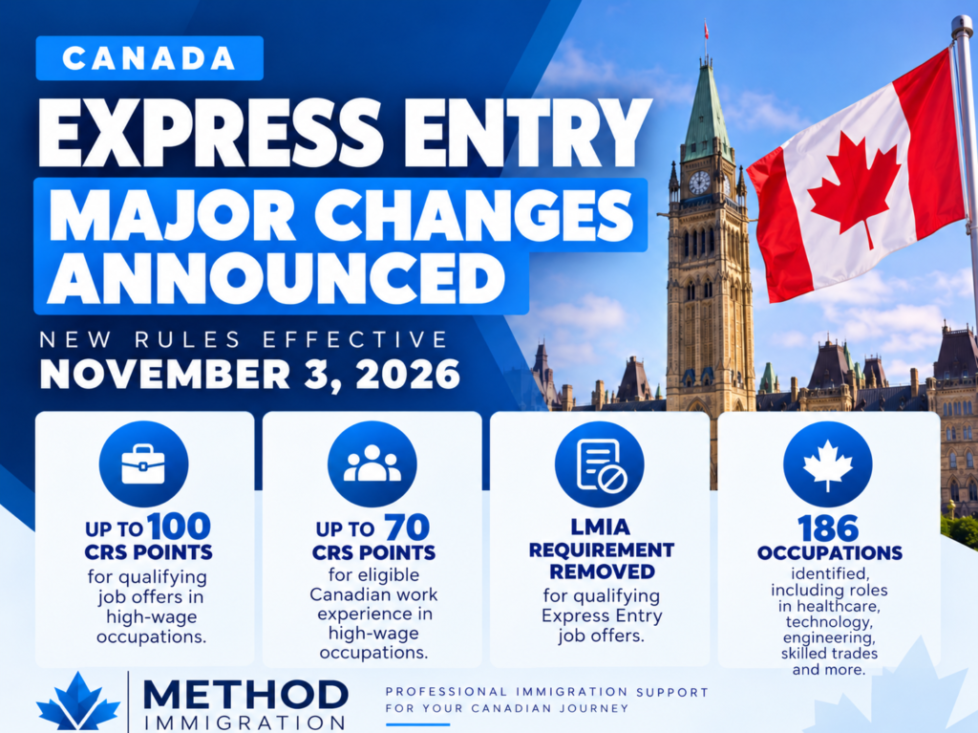
On October 16, 2026, Immigration, Refugees and Citizenship Canada (IRCC) announced reforms to the Comprehensive Ranking System (CRS), including the return of points for qualifying job offers, additional points for Canadian work experience in high-wage occupations, and the removal of Labour Market Impact Assessment (LMIA) requirements for qualifying job offers.
The changes will take effect on November 3, 2026, and could have a significant impact on the CRS scores of candidates already in the Express Entry pool.
What Is Changing Under Express Entry?
The reforms introduce a new CRS component called the Labour Market Integration Factor, designed to recognize candidates with qualifying Canadian work experience or job offers in occupations considered high-wage.
Under the new system, candidates may receive:
- Up to 100 CRS points for a qualifying job offer in an eligible high-wage occupation.
- Up to 70 additional CRS points for eligible Canadian work experience in a high-wage occupation.
- A simplified job offer assessment process that no longer requires an LMIA for qualifying Express Entry job offers.
Importantly, candidates cannot combine job offer points with Canadian work experience points under the new Labour Market Integration Factor. Instead, IRCC will award whichever option provides the higher score.
Up to 100 CRS Points for Qualifying Job Offers
One of the most significant changes is the reintroduction of CRS points for eligible job offers.
Candidates with qualifying offers in designated high-wage occupations may receive additional points depending on the wage classification of their occupation.
| High-Wage Occupation Classification | CRS Points |
|---|---|
| Median wage at least twice the national average median wage | 100 |
| Median wage at least 1.5 times the national average median wage | 70 |
| Median wage at least 1.3 times the national average median wage | 50 |
These classifications are determined by IRCC using National Occupational Classification (NOC) codes and labour market wage data.
The assessment is based on the occupation’s national wage classification rather than simply the salary offered to an individual worker.
A qualifying job offer must also meet the applicable Express Entry requirements. Not every job offer will qualify for additional CRS points.
Additional CRS Points for Canadian Work Experience
Candidates who have already gained qualifying work experience in Canada may also benefit from the new rules.
Individuals with at least 12 months of eligible Canadian work experience in designated high-wage occupations may qualify for additional CRS points.
The amount awarded depends on the occupation’s wage classification:
| Eligible Canadian Work Experience | Additional CRS Points |
|---|---|
| At least 12 months in an occupation meeting the 2× threshold | 70 |
| At least 12 months meeting the 1.5× threshold | 40 |
| At least 12 months meeting the 1.3× threshold | 20 |
These additional points are awarded alongside the existing CRS points for the length of qualifying Canadian work experience.
For example, a candidate who has worked in Canada in an eligible high-wage occupation could see their overall CRS score increase even without a qualifying job offer.
However, meeting the work experience requirements and correctly identifying the occupation’s NOC classification will be essential.
LMIA Requirements Removed for Qualifying Job Offers
Another important reform involves Labour Market Impact Assessments (LMIAs).
Beginning November 3, 2026, an LMIA will no longer be required for a qualifying job offer to receive Express Entry CRS points.
Previously, LMIA requirements could create additional steps for certain employers and applicants.
Under the updated system, IRCC will assess whether an employment offer is genuine and meets the applicable immigration requirements.
This includes reviewing whether:
- The employer is actively operating a legitimate business.
- The position reflects a genuine employment need.
- The employer can reasonably fulfil the terms of employment.
- The candidate is qualified and able to perform the job.
- The offer complies with applicable employment and recruitment legislation.
Important: The removal of LMIA requirements for Express Entry job offers does not eliminate LMIA requirements for all Canadian work permits. Separate rules continue to apply to temporary foreign worker applications.
Which Occupations Could Benefit?
The new high-wage occupation classifications include a wide range of professional, technical, healthcare, management and skilled trade occupations.
Examples of occupations appearing on IRCC’s eligible lists include:
- Software engineers and developers
- Civil and mechanical engineers
- Registered nurses
- Dentists and pharmacists
- Electricians and skilled trades professionals
- Financial managers
- Construction managers
- Human resources professionals
- Physicians and nurse practitioners
Not all these occupations qualify for the same number of points.
Applicants should review the official list of eligible NOC codes to determine whether their employment or job offer qualifies.
IRCC has identified 186 occupations across the three high-wage classifications.
What Happens to Existing Express Entry Profiles?
Candidates who already have an active Express Entry profile should pay particular attention to these changes.
IRCC has confirmed that existing CRS scores will be recalculated when the new rules take effect on November 3, 2026.
The recalculation process may take up to two weeks.
During this period, Express Entry invitation rounds will be temporarily paused and will resume once the system updates are complete.
Candidates who have a qualifying job offer that is not currently reflected in their Express Entry profile should review and update their information before November 3.
Those who qualify for additional Canadian work experience points may have their scores adjusted automatically using their existing profile information.
It is important that all information submitted to IRCC remains accurate and up to date.
Will These Changes Improve Your Chances of Permanent Residence?
For some candidates, the reforms could lead to a meaningful increase in their CRS scores.
Those with qualifying Canadian work experience or eligible high-wage job offers may become more competitive in future Express Entry invitation rounds.
However, candidates should remember that an increased CRS score does not guarantee an Invitation to Apply (ITA) for permanent residence.
Selection will continue to depend on factors including:
- CRS cut-off scores in future invitation rounds.
- Eligibility under an Express Entry-managed immigration program.
- The type of invitation round conducted by IRCC.
- The candidate’s qualifications and immigration circumstances.
Candidates whose occupations are not on the high-wage list may still qualify for Express Entry through existing immigration pathways.
What Should Express Entry Candidates Do Now?
With the changes approaching, prospective applicants and existing Express Entry candidates should review their immigration options.
1. Check your NOC classification
Determine whether your current or proposed occupation appears on IRCC’s eligible high-wage occupation list.
2. Review your Canadian work experience
Ensure that your employment history accurately reflects your qualifying Canadian work experience.
3. Check your job offer details
If you have a qualifying job offer, make sure the required information is included in your Express Entry profile before November 3, 2026.
4. Reassess your CRS score
Consider how the changes may affect your CRS score and your prospects in future invitation rounds.
5. Seek professional immigration advice
Immigration rules can be complex, particularly when assessing job offers, Canadian work experience and program-specific eligibility.
Obtaining professional guidance can help applicants understand how the new rules apply to their individual circumstances.
How Method Immigration Can Help
At Method Immigration, we understand that changes to Canada’s immigration system can create both opportunities and uncertainty.
Whether you are already in the Express Entry pool, currently working in Canada or exploring your options for Canadian permanent residence, understanding how these reforms apply to you is essential.
Our Regulated Canadian Immigration Consultant (RCIC) can help you:
- Understand your eligibility for Express Entry.
- Review your qualifications and Canadian work experience.
- Identify potential immigration pathways.
- Understand how the new CRS rules may affect your profile.
- Plan the next steps in your Canadian immigration journey.
Book an immigration consultation with Method Immigration today.
Visit https://method-immigration.com to learn more about our services and schedule a consultation.