
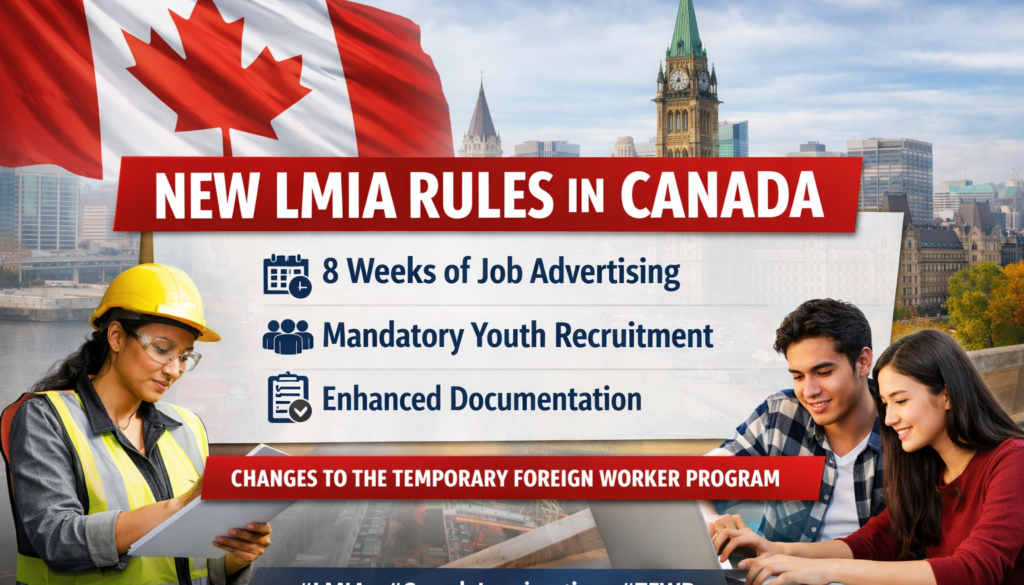
Canada Introduces Stricter LMIA Rules
New LMIA Rules Double Advertising Period and Require Employers to Target Youth
As of April 1, 2026, significant changes to Canada’s Labour Market Impact Assessment (LMIA) process have come into effect, impacting employers who hire through the low-wage stream of the Temporary Foreign Worker Program (TFWP).
The updated rules introduce stricter recruitment requirements, including a longer advertising period and mandatory efforts to recruit youth in Canada before employers can hire foreign workers.
Advertising Period Extended to Eight Weeks
One of the most notable changes is the extension of the minimum job advertising period. Employers must now advertise open positions for at least eight consecutive weeks—double the previous four-week requirement.
These advertisements must still be completed within the three months leading up to the LMIA application. In addition, at least one recruitment activity must remain active until a final decision is issued.
This extended timeline means employers will need to plan their hiring processes further in advance, particularly in industries that rely heavily on foreign workers to address labour shortages.
Mandatory Youth Recruitment Efforts
Employers are now also required to demonstrate that they made meaningful efforts to recruit youth in Canada before seeking to hire foreign nationals.
This new requirement is designed to ensure that young Canadians are given greater access to job opportunities. While there is no strict definition, “youth” generally refers to individuals between the ages of 15 and 30.
To meet this obligation, employers may:
- Advertise on youth-focused job boards and platforms
- Partner with schools, colleges, and universities
- Participate in youth employment programs
- Promote roles through community organizations
- Use digital and social platforms popular among younger job seekers
These efforts are now considered a distinct and mandatory component of LMIA recruitment.
Increased Documentation and Compliance
With the new rules, employers must maintain detailed records of all recruitment activities for a minimum of six years. They are also required to provide evidence of their hiring efforts and outcomes when submitting an LMIA application.
Failure to meet these requirements could result in application delays or refusals.
What This Means for Employers
The latest changes reflect Canada’s continued effort to prioritize domestic employment, particularly among youth, while tightening access to the TFWP.
For employers, this means:
- Longer hiring timelines
- More structured recruitment strategies
- Greater emphasis on compliance and documentation
Businesses that depend on foreign workers will need to adapt quickly to remain compliant and competitive.
Navigating the New LMIA Landscape
With evolving regulations and increased scrutiny, navigating the LMIA process has become more complex than ever.
Method Immigration supports employers across Canada with tailored LMIA and TFWP solutions—from developing compliant recruitment strategies to preparing strong applications.
As policies continue to evolve, expert guidance can make a critical difference in securing successful outcomes.
LMIA #CanadaImmigration #TFWP