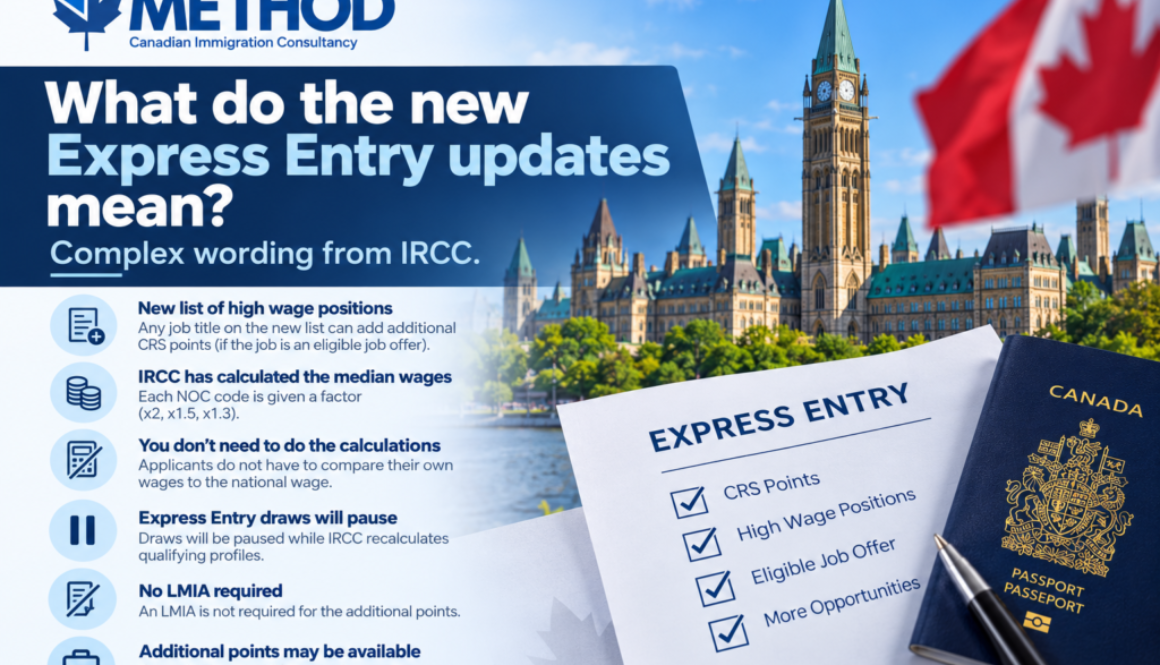
IRCC have released a recent update to CRS points within the Express Entry system. However, the wording is very complex and hard to interpret. Please see a clearer explanation below:
– Any job title on the new list of ‘high wage positions’ (link below), can add additional points to an Express Entry Application (if the job is an ‘eligible job offer’ according to IRCC) – without the Applicant needing to meet the median wage requirement. This is the case even if the Applicant does not meet the median wage requirement for their particular NOC code. ‘High wage positions’ list is here: https://www.canada.ca/en/immigration-refugees-citizenship/services/immigrate-canada/express-entry/check-score/high-wage.html#list
– IRCC have automatically calculated the median wages for each NOC code – and given them a factor (x2; x1.5; x1.3).
– The Applicant does not have to calculate or compare their own wages to the National Canadian wage for that NOC code.
– The Express Entry draws will pause while the system recalculates qualifying profiles.
– No LMIA is required for the additional points.
– If you also have qualifying work experience in the NOC code, you may be able to claim additional points for that too.
If you believe you may qualify but have additional questions, please contact us to help admin@method-immigration.com
Canada is introducing significant changes to its immigration system in 2026, including reforms to Express Entry. However, for Americans with Canadian parents, grandparents or even great-grandparents, there may be a more direct route to Canadian citizenship.
Changes to Canada’s Citizenship Act that took effect on December 15, 2025, have expanded eligibility for citizenship by descent, potentially allowing many individuals born outside Canada to be recognized as Canadian citizens.
For eligible Americans, this could mean obtaining Canadian citizenship without first applying for permanent residence, securing a Canadian job offer or relocating to Canada.
What Has Changed Under Canada’s Citizenship Act?
On December 15, 2025, amendments introduced through Bill C-3 came into effect, changing how Canadian citizenship can be passed down to children born outside Canada.
Previously, Canada’s first-generation limit generally prevented Canadian citizens born abroad from automatically passing citizenship to their own children who were also born outside Canada.
The legislative changes have removed this restriction for many individuals born before December 15, 2025.
As a result, some people who previously did not qualify for Canadian citizenship may now be recognized as citizens through their Canadian family ancestry.
This could include individuals with:
A Canadian-born parent.
A Canadian grandparent.
A Canadian great-grandparent.
More distant Canadian ancestry, where citizenship can be established through successive generations.
Importantly, having a Canadian ancestor does not automatically guarantee eligibility. Individual circumstances, including family history, adoption, previous citizenship losses and applicable legal provisions, must be considered.
Do Americans With Canadian Grandparents Qualify for Citizenship?
Potentially, yes.
For example, an American born in the United States whose grandparent was born in Canada may now have a claim to Canadian citizenship, even if their parent was also born outside Canada.
Depending on their circumstances, the individual may already be a Canadian citizen under the amended legislation.
Rather than applying to become a citizen through the traditional immigration process, they may be eligible to apply for a Canadian citizenship certificate, which provides official proof of an existing citizenship status.
This distinction is important because obtaining proof of citizenship is different from applying for citizenship through naturalization.
Do You Need to Live in Canada to Claim Citizenship by Descent?
For individuals who already qualify as Canadian citizens through descent, there is generally no requirement to move to Canada before applying for proof of citizenship.
Eligible applicants may be able to complete the process while continuing to live in the United States or another country.
Canadian citizens have the right to live and work in Canada without needing a work permit or permanent resident status.
Canada and the United States also generally permit dual citizenship, meaning an eligible American may be able to hold both Canadian and American citizenship.
Citizenship Applications Are Increasing
Interest in Canadian citizenship by descent has reportedly increased significantly following the legislative changes.
According to figures reported in October 2026, the number of people awaiting decisions on proof of Canadian citizenship applications had increased from approximately 70,400 in May 2026 to 130,700 in October.
Estimated processing times have also risen to approximately 34 months for new applications.
These processing times are estimates and may change as Immigration, Refugees and Citizenship Canada (IRCC) responds to increased application volumes.
Individuals considering an application should review current processing times and ensure they have the documentation needed to establish their citizenship claim.
What Documents May Be Required?
Individuals applying for proof of Canadian citizenship through ancestry will generally need documentation establishing their family relationship to the relevant Canadian ancestor.
Depending on the circumstances, this may include:
Birth certificates showing the relationship between generations.
Canadian birth certificates or citizenship records.
Marriage certificates or legal name-change documents.
Adoption records, where applicable.
Identity documents and other supporting evidence.
For families with multiple generations born outside Canada, gathering historical documents may require additional research.
How Are the New Express Entry Changes Different?
Canada is also introducing changes to its Express Entry system, with reforms scheduled to take effect on November 3, 2026.
The announced changes include a greater emphasis on high-wage Canadian employment and work experience when assessing certain candidates for permanent residence.
Express Entry is designed to manage immigration applications from eligible skilled workers who wish to become permanent residents.
Citizenship by descent, however, operates under a separate legal framework.
Individuals who are already Canadian citizens through descent do not need to qualify for Express Entry to establish their citizenship.
For Americans with qualifying Canadian ancestry, this distinction could be particularly important as Canada’s economic immigration selection system continues to evolve.
What About Children Born After December 15, 2025?
The updated citizenship legislation also includes specific requirements for certain children born outside Canada on or after December 15, 2025.
Where a Canadian parent was also born or adopted outside Canada, the parent may need to demonstrate a substantial connection to Canada.
This generally involves showing at least 1,095 days of physical presence in Canada before the child’s birth or adoption, subject to the applicable legislative requirements.
Families should therefore avoid assuming that the same eligibility rules apply to every generation or every date of birth.
Why Is Canadian Citizenship by Descent Important?
For eligible individuals, Canadian citizenship can provide several significant benefits.
These include the ability to live, work and study in Canada without immigration permits, access to a Canadian passport subject to passport requirements, and the opportunity to establish a future life in Canada.
For some families, citizenship recognition may also help clarify the citizenship status of children and future generations.
However, eligibility for healthcare, education benefits and other services can depend on residency and additional provincial or federal requirements.
How Method Immigration Can Help
If you were born outside Canada and have Canadian parents, grandparents or more distant Canadian ancestry, you may have a citizenship claim worth exploring.
At Method Immigration, we understand that Canadian citizenship and immigration rules can be complex, particularly when multiple generations and historical records are involved.
Our regulated Canadian immigration consultant can help you understand the relevant requirements, assess potential immigration and citizenship pathways, and determine appropriate next steps for your circumstances.
Do you have Canadian ancestry and want to explore your options?
Contact Method Immigration to arrange a consultation and learn more about your potential eligibility.
Disclaimer: This article provides general information and does not constitute individualized immigration or legal advice. Eligibility and application requirements depend on individual circumstances and the legislation in effect.
Recommended SEO settings
Field
Suggested content
SEO title
Canadian Citizenship by Descent: New Rules for Americans in 2026
URL slug
canadian-citizenship-by-descent-americans-2026
Focus keyword
Canadian citizenship by descent
Secondary keywords
Bill C-3, Canadian ancestry, dual citizenship, Canadian grandparents
Category
Canadian Citizenship
Meta description
Have Canadian parents or grandparents? Discover how Canada’s 2025 citizenship law changes could make you eligible for Canadian citizenship in 2026.
Source verification: IRCC confirms that Bill C-3 took effect on December 15, 2025, and that different rules apply to children born before and after that date.
Canada
IRCC also confirms the announced November 3 Express Entry reforms.
Canada
+1
The article is suitable for publication after Method Immigration reviews the legal details and confirms the current processing-time estimate.
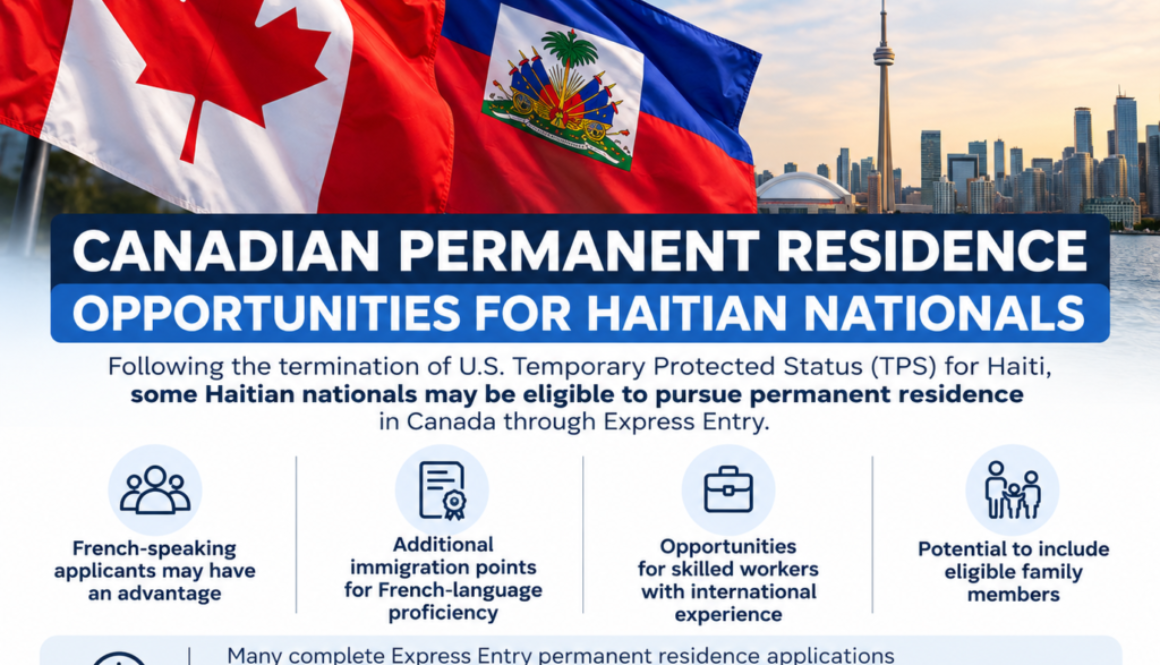
Haitian nationals facing uncertainty following the termination of Temporary Protected Status (TPS) in the United States may have an opportunity to build a future in Canada through the country’s Express Entry immigration system.
With Canada continuing to prioritize French-speaking immigration candidates, eligible Haitian nationals could benefit from targeted Express Entry draws and permanent residence application processing times of approximately six months.
However, applicants must meet the eligibility requirements, receive an invitation to apply, and submit a complete application before permanent residence can be granted.
What Has Changed for Haitian Nationals in the United States?
The United States terminated its Temporary Protected Status designation for Haiti effective July 27, 2026, creating significant uncertainty for affected individuals and families.
For Haitian nationals considering alternative immigration opportunities, Canada may offer a pathway to long-term stability through its established economic immigration programs.
One particularly relevant option is Express Entry, which manages applications from skilled workers seeking Canadian permanent residence.
Why French-Speaking Haitians May Have an Advantage
Canada continues to prioritize French-speaking immigrants as part of its efforts to strengthen Francophone communities outside Quebec.
Haitian nationals who speak French may be well positioned to benefit from these immigration priorities.
Under Express Entry, eligible applicants can benefit from:
Additional Comprehensive Ranking System (CRS) points for French-language proficiency.
Dedicated category-based selection rounds for candidates with qualifying French-language skills.
Opportunities to qualify through overseas skilled work experience.
The ability to include eligible spouses, partners, and dependent children in permanent residence applications.
To qualify for French-language category-based selection, candidates must generally demonstrate a minimum score of NCLC 7 in all four French-language abilities through an approved test.
Meeting this language threshold does not automatically guarantee an invitation. Applicants must also qualify for an Express Entry program and satisfy the applicable selection criteria.
Who May Be Eligible for Express Entry?
For many Haitian nationals living in the United States, the Federal Skilled Worker Program (FSWP) may be a suitable immigration pathway.
Applicants generally need to meet requirements including:
At least one year of continuous, paid, skilled work experience in an eligible occupation within the previous ten years.
A minimum language proficiency of CLB 7 in English or NCLC 7 in French.
A Canadian educational credential or an eligible foreign credential supported by an Educational Credential Assessment (ECA).
At least 67 points out of 100 under the Federal Skilled Worker selection grid.
Sufficient settlement funds, unless an exemption applies.
An intention to live outside Quebec.
Applicants must also meet Canada’s admissibility requirements.
Can Permanent Residence Really Be Obtained in Six Months?
Express Entry is one of Canada’s principal pathways for skilled workers seeking permanent residence.
According to processing information reported in October 2026, approximately 78% of Express Entry permanent residence applications were processed within six months or less during the August 2025 to July 2026 period.
However, this processing timeframe generally begins once Immigration, Refugees and Citizenship Canada (IRCC) receives a complete permanent residence application.
It does not include the time needed to prepare language tests, obtain educational assessments, enter the Express Entry pool, or wait for an invitation to apply.
Processing times are estimates, and individual applications may take longer.
How to Apply for Canadian Permanent Residence
Eligible candidates can begin by determining whether they qualify for one of the immigration programs managed through Express Entry.
The process generally involves:
Assessing eligibility: Review work experience, education, language proficiency, and other immigration requirements.
Completing language testing: Take an approved English or French language test.
Obtaining an ECA: Have foreign educational qualifications assessed where required.
Creating an Express Entry profile: Enter the candidate pool and receive a CRS score.
Receiving an invitation: Eligible candidates may be invited through general, program-specific, or category-based draws.
Submitting a permanent residence application: Candidates generally have 60 days after receiving an invitation to submit their complete application.
Awaiting a decision: IRCC reviews the application, including medical, criminality, and security requirements.
Successful applicants can become Canadian permanent residents and establish their lives in Canada.
What About Haitian Nationals Already in Canada?
Canada also has temporary immigration measures for certain Haitian nationals already in the country.
Some eligible individuals may be able to extend their temporary resident status or apply for work or study permits under special public policies currently scheduled to expire on October 27, 2026.
These measures have specific eligibility requirements and are separate from Express Entry permanent residence pathways.
How Method Immigration Can Help
Understanding Canadian immigration eligibility can be challenging, particularly when immigration policies and personal circumstances are changing.
At Method Immigration, we provide professional guidance to individuals and families exploring their options for living and working in Canada.
Our services can help you understand:
Whether you qualify for Express Entry.
How your French or English proficiency may affect your CRS score.
Whether your international work experience and education meet Canadian immigration requirements.
Which permanent residence pathways may be suitable for your circumstances.
What documentation and preparation may be required.
Considering a move to Canada?
Book a consultation with Method Immigration to discuss your eligibility and explore your Canadian immigration options.
Disclaimer: This article provides general immigration information as of October 6, 2026 and does not constitute individualized immigration or legal advice. Immigration policies, selection criteria, and processing times may change. Eligibility and approval are not guaranteed.
Canada has issued another round of invitations to senior managers with Canadian work experience through the Express Entry system.
On September 16, 2026, Immigration, Refugees and Citizenship Canada (IRCC) issued 250 Invitations to Apply (ITAs) for permanent residence in a category-based Express Entry draw targeting senior managers with Canadian work experience.
The minimum Comprehensive Ranking System (CRS) score was 389.
This was the third Express Entry draw specifically targeting senior managers with Canadian work experience in 2026. The latest draw also recorded the lowest CRS cut-off to date for this category.
Key details of the draw
Draw date
September 16, 2026
Draw type
Senior Managers with Canadian Work Experience
Invitations issued
250
Minimum CRS score
389
Tie-breaking date
September 1, 2026
Candidates with a CRS score of 389 needed to have submitted their Express Entry profile before the applicable tie-breaking date in order to receive an invitation.
Who qualifies as a senior manager?
Canada introduced the senior managers with Canadian work experience category as part of its 2026 Express Entry category-based selection system.
According to IRCC, candidates must have accumulated at least 12 months of full-time Canadian work experience, or an equivalent amount of part-time experience, within the previous three years.
The experience must have been gained in one of the following occupations:
NOC 00012 – Senior managers – financial, communications and other business services
NOC 00013 – Senior managers – health, education and social and community services and membership organizations
NOC 00014 – Senior managers – trade, broadcasting and other services
NOC 00015 – Senior managers – construction, transportation, production and utilities
The Canadian work experience does not have to be continuous, provided the candidate meets the applicable requirements.
Candidates must also meet the requirements for an underlying Express Entry program and satisfy the specific requirements established for the category-based draw.
CRS cut-off continues to fall
The September draw represents a notable change from earlier senior-manager selections in 2026.
IRCC’s previous senior-manager draws were:
March 5, 2026: 250 ITAs – CRS 429
July 10, 2026: 500 ITAs – CRS 392
September 16, 2026: 250 ITAs – CRS 389
Across these three draws, IRCC has issued a total of 1,000 invitations to senior managers with Canadian work experience.
The latest CRS cut-off was 40 points lower than the first senior-manager draw held in March.
It is important to note that CRS cut-offs can vary from one Express Entry draw to another. A previous cut-off should not be interpreted as a guaranteed score for a future invitation round.
Canada’s continued focus on Canadian work experience
The senior-manager draw forms part of Canada’s broader 2026 approach to Express Entry, which includes targeted category-based selections.
IRCC announced senior managers with Canadian work experience as one of the new categories introduced for 2026, alongside researchers with Canadian work experience, physicians with Canadian work experience, transport occupations and skilled military recruits.
Other Express Entry categories receiving invitations during 2026 have included the Canadian Experience Class, French-language proficiency, healthcare and social services, trades, transport, physicians with Canadian work experience and provincial nominees.
This means candidates who are already working in Canada may have opportunities through multiple Express Entry pathways, depending on their occupation, work experience, language ability, CRS score and other eligibility factors.
What should senior managers in Canada do now?
Senior managers working in Canada who may qualify for this category should review their Express Entry eligibility and ensure that their work experience is accurately classified under the appropriate NOC.
Candidates should also review their:
Canadian work experience;
Language test results;
Education and Educational Credential Assessment, where applicable;
CRS score;
Express Entry program eligibility; and
Proof of work experience and other supporting documentation.
A CRS score below a previous draw’s cut-off does not necessarily mean that a candidate has no pathway to permanent residence. Different Express Entry categories and provincial immigration programs can have different eligibility requirements and selection criteria.
How Method Immigration can help
If you are a senior manager currently working in Canada and are considering permanent residence, understanding which immigration pathway best matches your circumstances is an important first step.
At Method Immigration, we can help you assess your Canadian work experience, Express Entry eligibility and potential immigration options.
Want to know whether you may qualify for Canadian permanent residence?
Contact Method Immigration to discuss your options with a regulated Canadian immigration consultant.
Canada has released its latest snapshot of the Express Entry candidate pool, providing applicants with a clearer picture of how Comprehensive Ranking System (CRS) scores are currently distributed among candidates waiting for an invitation to apply for permanent residence.
The latest data, covering the Express Entry pool as of September 13, 2026, shows that the pool contained 226,793 candidate profiles.
While the overall pool increased by only 120 profiles compared with the previous snapshot from August 30, there were significant changes within individual CRS score ranges.
Significant increase in candidates with CRS scores above 500
One of the most notable changes was the increase in candidates in the 501–600 CRS range.
As of September 13, there were 20,784 candidates in this range, compared with 19,542 on August 30 — an increase of 1,242 profiles.
The number of candidates in the 601–1,200 range also increased slightly, from 559 to 574.
Combined, there were 21,358 candidates with CRS scores above 500 in the September 13 pool.
This represents approximately 9.4% of the entire Express Entry pool.
At the same time, the number of candidates in several score ranges below 500 declined.
The 471–480 range decreased by 876 profiles, while the 481–490 range declined by 847. The 491–500 range also decreased by 362 candidates.
How is the Express Entry pool distributed?
According to the September 13 data, the largest group of candidates was in the 351–400 CRS range, containing 46,782 profiles.
The distribution was:
CRS score range
Candidates
0–300
7,746
301–350
17,240
351–400
46,782
401–410
11,033
411–420
11,506
421–430
12,064
431–440
13,300
441–450
13,657
451–460
14,823
461–470
16,163
471–480
16,105
481–490
12,426
491–500
12,590
501–600
20,784
601–1,200
574
Total
226,793
The figures demonstrate that the Express Entry pool remains concentrated across a wide range of CRS scores rather than being dominated by candidates in a single score bracket.
Recent Express Entry draws have removed thousands of candidates
The changes in the pool occurred alongside several Express Entry invitation rounds.
Between August 30 and September 13, Immigration, Refugees and Citizenship Canada (IRCC) conducted four draws and issued a combined 6,291 invitations to apply (ITAs).
These included:
August 31: Provincial Nominee Program — 562 ITAs, CRS 697
September 1: Canadian Experience Class — 2,000 ITAs, CRS 521
September 3: Physicians with Canadian Work Experience — 229 ITAs, CRS 198
September 4: Healthcare and Social Services — 3,500 ITAs, CRS 475
The September 4 Healthcare and Social Services draw is particularly notable because its CRS cutoff was substantially below the recent Canadian Experience Class cutoffs.
Two additional draws took place after the September 13 snapshot
The September 13 candidate distribution does not include two subsequent Express Entry draws held on September 14 and September 15.
On September 14, IRCC invited 576 provincial nominees, with a minimum CRS score of 734.
On September 15, IRCC issued another 2,000 invitations through the Canadian Experience Class, with a minimum CRS score of 519.
Following these two draws, IRCC had issued 128,732 Express Entry ITAs during 2026, according to the latest available figures.
Because the September 13 pool snapshot predates these two draws, the composition of the current pool will change as IRCC updates its candidate data.
Category-based selection remains important
Express Entry is not limited to general draws.
IRCC can conduct category-based selection rounds targeting candidates who meet specific economic or labour-market priorities. Candidates must still qualify for one of the economic immigration programs managed through Express Entry.
These include:
Canadian Experience Class (CEC)
Federal Skilled Worker Program (FSWP)
Federal Skilled Trades Program (FSTP)
Candidates are ranked using the Comprehensive Ranking System, which considers factors including age, education, official-language proficiency and Canadian and foreign work experience.
Category-based draws can produce different CRS cutoffs from Canadian Experience Class or other general invitation rounds.
For example, in 2026, Healthcare and Social Services draws have had CRS cutoffs in the 467–475 range, while Canadian Experience Class draws have ranged from 507 to 523 according to the latest reported results.
What does the latest data mean for Express Entry candidates?
The latest figures reinforce an important point for prospective permanent residents: there is no single CRS score that guarantees an invitation through Express Entry.
The score required can vary depending on the type of draw, the number of invitations issued, the number and characteristics of candidates in the pool, and the category being targeted.
Candidates should therefore assess more than their CRS score alone.
Factors such as eligibility for a category-based draw, Canadian work experience, language results, education, provincial nomination opportunities and other immigration pathways may all be relevant when developing a permanent residence strategy.
IRCC also continues to conduct Express Entry rounds approximately every two weeks, although the timing, draw type, number of invitations and CRS cutoff can vary.
Method Immigration
For individuals considering Express Entry, understanding the current CRS environment is only one part of the process.
A candidate’s eligibility, CRS calculation, work experience, language results, education and potential category-based or provincial pathways should be reviewed together before deciding on an immigration strategy.
Method Immigration provides Canadian immigration consulting services to help individuals and families assess their options and prepare their applications.
If you are considering Express Entry and want to understand how your profile may fit within Canada’s current economic immigration programs, contact Method Immigration to discuss your options.
French-speaking workers looking to make Canada their permanent home may have a new opportunity to pursue permanent residence through the Francophone Community Immigration Pilot (FCIP) in Greater Sudbury, Ontario.
Greater Sudbury is continuing to welcome French-speaking skilled workers through its community-based immigration pathway, with the region expected to advance up to 85 candidates with qualifying local job offers in 2026.
According to recent information from Greater Sudbury Economic Development, 32 candidates had already been recommended as of August 30, leaving 53 allocations available for the remainder of the year.
For eligible workers, the program can provide a pathway from a qualifying job offer to a community recommendation and, ultimately, an application for Canadian permanent residence.
What is the Francophone Community Immigration Pilot?
The FCIP is a federal immigration pilot designed to help Francophone-minority communities attract and retain skilled workers.
The program is currently open and operates in six communities across Canada, including:
Greater Sudbury, Ontario
Timmins, Ontario
Superior East Region, Ontario
Acadian Peninsula, New Brunswick
St. Pierre Jolys, Manitoba
Kelowna, British Columbia
The goal is to connect newcomers with local employers experiencing labour shortages while encouraging successful settlement in Francophone communities outside Quebec.
Which workers is Sudbury looking for?
For 2026, Greater Sudbury is prioritizing workers in six broad sectors:
Arts, Culture, Recreation and Sport
Business, Finance and Administration
Education, Social, Community and Government Services
Health
Natural Resources and Agriculture
Trades and Transport
The community has identified 25 priority occupations for the 2026 program year.
These include occupations such as:
Administrative assistants
Accounting technicians and bookkeepers
Automotive service technicians
Carpenters
Construction millwrights and industrial mechanics
Construction trades helpers and labourers
Dispatchers
Early childhood educators and assistants
Home support workers and caregivers
Nurse aides, orderlies and patient service associates
Social and community service workers
Transport truck drivers
Welders
Other occupations identified by Greater Sudbury
Some occupations have additional community-specific restrictions. For example, Greater Sudbury has indicated that no more than two recommendation applications will be accepted for cashier positions in 2026.
Who can qualify?
Having French-language ability alone does not make someone eligible for the FCIP.
Applicants must meet both federal requirements and Greater Sudbury’s community-specific requirements.
Under the federal FCIP rules, applicants generally need:
A valid job offer from a designated employer in the participating community;
At least one year (1,560 hours) of related work experience within the previous three years, unless an applicable exemption applies;
An approved language test demonstrating the required French proficiency;
A Canadian educational credential or an eligible foreign equivalent;
Sufficient settlement funds, unless exempt; and
A community recommendation before applying for permanent residence.
For the FCIP, the minimum French-language requirement is generally NCLC 5 in all four language abilities—reading, writing, listening and speaking. Approved French tests include TEF Canada and TCF Canada.
A job offer is an important first step
One of the most important features of the FCIP is that applicants need a qualifying job offer from a designated employer in the participating community.
The position must also meet the community’s requirements regarding priority sectors and occupations.
Once a designated employer makes an eligible job offer, the employer submits a recommendation application to the community on behalf of the worker. If the community recommends the candidate, the applicant can then submit their permanent residence application to Immigration, Refugees and Citizenship Canada (IRCC).
This makes the program particularly important for workers who may have difficulty competing through other economic immigration programs but have the skills, French-language ability and a genuine opportunity to work in a participating community.
What are the remaining 2026 intake dates?
Greater Sudbury has indicated that recommendation applications are accepted during designated intake windows.
For the remainder of 2026, the reported intake windows are:
September 28–October 2, 2026
and
November 2–6, 2026
Applications placed into the community’s candidate pool can remain there for up to six months before expiring.
Because the number of available recommendations is limited, meeting the basic requirements does not necessarily guarantee that a candidate will receive a community recommendation.
A potential work permit option
The FCIP may also provide an important temporary status option for eligible applicants.
After receiving a community recommendation and applying for permanent residence, an eligible applicant may be able to obtain a two-year work permit while their permanent residence application is processed.
The FCIP-specific work permit allows the applicant to work for the employer that provided the qualifying job offer.
A spouse or common-law partner may also be eligible for an open work permit, although their authorization is restricted to working within the same participating community.
Why this matters for French-speaking immigrants
The Sudbury FCIP is another example of Canada’s broader strategy of using community-based immigration programs to attract newcomers to areas outside Canada’s largest metropolitan centres.
For French-speaking workers, this can create an additional immigration option—particularly for those whose occupation, work experience and language profile align with the needs of a participating community.
It is also important to understand that a French-speaking applicant is not automatically eligible simply because they speak French. The job offer, occupation, work experience, language results, education, settlement requirements and community recommendation all need to be carefully assessed.
Could the Sudbury FCIP be right for you?
If you speak French and are considering permanent residence in Canada, the FCIP may be worth exploring if you have—or can obtain—a qualifying employment opportunity in Greater Sudbury.
Immigration programs can have detailed eligibility requirements, and community-specific criteria can be just as important as the federal requirements. A mistake in assessing the occupation, job offer, work experience or language requirements could affect your ability to pursue the pathway.
Method Immigration can help you assess your options and determine whether a community-based immigration pathway may fit your circumstances.
If you are considering the Francophone Community Immigration Pilot or another Canadian permanent residence program, contact Method Immigration to discuss your immigration options and next steps.
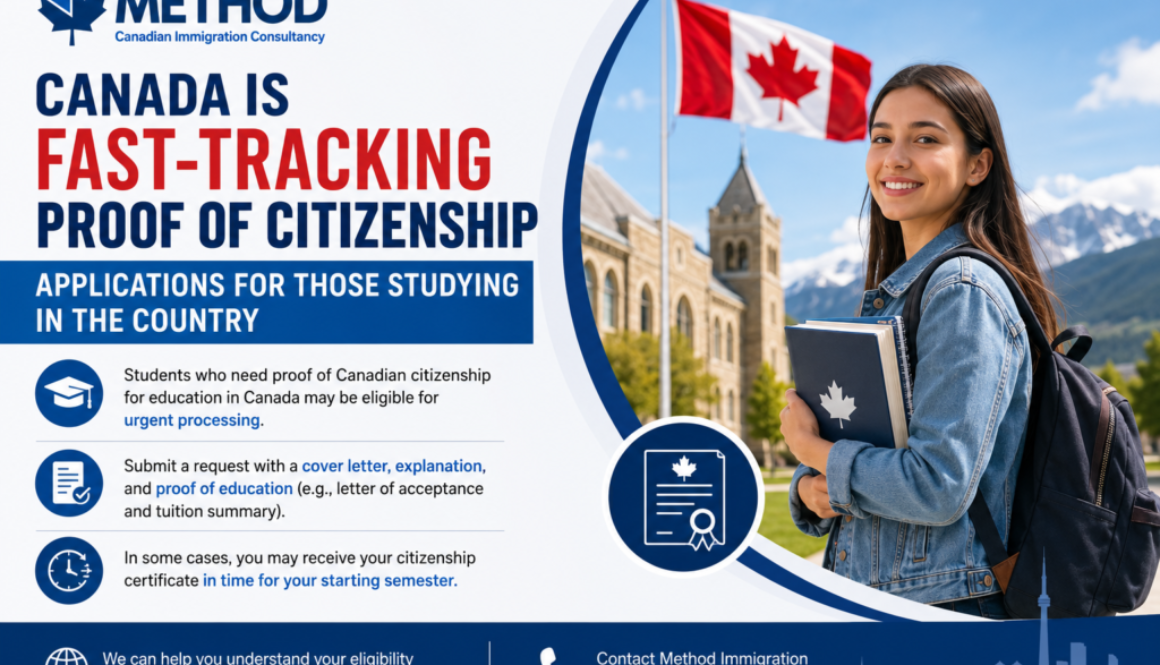
Canada is offering urgent processing for certain proof of Canadian citizenship applications from people who need their citizenship certificate for education in Canada.
The option could be particularly important for people who are Canadian citizens by descent but are waiting for official proof of citizenship before beginning their studies.
In some cases, eligible applicants may receive their citizenship certificate in time for the start of their academic semester.
Why proof of citizenship applications are taking longer
Demand for Canadian citizenship certificates has increased significantly following changes to Canada’s citizenship-by-descent rules.
On December 15, 2025, Bill C-3 came into effect, removing the previous first-generation limit on citizenship by descent in many circumstances. The changes opened a pathway to Canadian citizenship for many people born outside Canada who have a Canadian parent or other qualifying connection.
As a result, IRCC has experienced a significant increase in proof of citizenship applications.
For many applicants, processing times have now extended beyond two years, making the urgent-processing option particularly important for those facing a fixed educational deadline.
Students may qualify for urgent processing
Immigration, Refugees and Citizenship Canada (IRCC) allows applicants to request urgent processing of a citizenship certificate when they require proof of citizenship for certain educational purposes.
Applicants do not automatically receive urgent processing simply because they are studying or planning to study in Canada. They must specifically request urgent processing and provide evidence supporting their request.
A request based on education should generally include:
A cover letter requesting urgent processing and explaining the applicable circumstances;
A letter explaining why the certificate is urgently required for the applicant’s education; and
Proof of education in Canada, such as a letter of acceptance from a Canadian educational institution and documentation showing tuition requirements.
The supporting evidence should be submitted with the applicant’s complete proof of citizenship application.
IRCC will then assess the request and determine whether urgent processing is justified.
Importantly, urgent processing is not guaranteed, and applicants should not assume that their certificate will arrive before their program begins.
Canadian citizenship can affect tuition fees
Obtaining proof of Canadian citizenship can also have significant financial implications for students.
Canadian citizens generally pay domestic tuition rates rather than international student tuition rates at Canadian colleges and universities. Depending on the institution and program, the difference can amount to thousands of dollars.
However, tuition policies vary between provinces and institutions.
For example, some institutions may have additional rules concerning residency. In Quebec, certain non-resident students can face higher tuition rates even if they hold Canadian citizenship or permanent residence.
Students should therefore confirm the applicable tuition rules directly with their educational institution.
Citizenship status and proof of citizenship are different
One important consideration is that being a Canadian citizen under Canadian law is not necessarily the same as having documentation that allows an educational institution to recognize that status.
A school may require a Canadian citizenship certificate or other acceptable proof of citizenship before changing a student’s tuition classification.
As a result, someone who is already legally a Canadian citizen but is still waiting for their citizenship certificate could initially be assessed under a different tuition category.
Students in this situation should speak with their institution about its policies and whether tuition can be reassessed after proof of citizenship is received.
Education is not the only reason for urgent processing
Education is just one circumstance in which IRCC may consider urgent processing of a proof of citizenship application.
Other circumstances that may qualify can include:
Starting or maintaining employment;
Travelling because of a death or serious illness in the family;
Avoiding certain hardship or serious consequences;
Bringing a minor child with a Canadian parent to Canada;
Resolving statelessness;
Meeting a deadline to renounce another citizenship; and
Accessing certain social benefits, including healthcare.
Each request is assessed individually, and IRCC does not guarantee urgent processing.
Applicants must also ensure that their underlying citizenship application is complete. An incomplete application can prevent processing, even where the applicant has requested urgent consideration.
Canadian citizenship can provide additional advantages
For people who qualify for Canadian citizenship by descent, obtaining proof of citizenship can provide benefits beyond tuition.
Canadian citizens can generally live and work in Canada without a work permit, and Canadian citizens studying in Canada are not subject to the same work restrictions that apply to international students holding study permits.
Canadian citizenship may also provide greater flexibility for international travel and, depending on the person’s circumstances and age, access to opportunities such as International Experience Canada (IEC).
What should applicants do?
Anyone who believes they are already a Canadian citizen through a parent or another qualifying connection should first determine whether they are eligible for Canadian citizenship.
If proof of citizenship is required for an upcoming Canadian study program, applicants should consider requesting urgent processing at the time they submit their application, while providing detailed evidence of their educational circumstances and deadline.
Because urgent processing is discretionary, applicants should avoid relying solely on the expedited request when making important education or travel arrangements.
Need help with your Canadian citizenship application?
Determining Canadian citizenship by descent and preparing a proof of citizenship application can be complicated, particularly following the changes introduced by Bill C-3.
Method Immigration can help you understand your potential eligibility and the documentation required for your application.
If you believe you may already be a Canadian citizen through your family history, or you need proof of citizenship for an upcoming study program in Canada, contact Method Immigration to discuss your options.
Canada has opened a new intake under the Francophone Minority Communities Student Pilot (FMCSP), providing eligible French-speaking international students with an opportunity to study in Canada and pursue permanent residence after completing their studies.
The 2026 intake opened on August 26, 2026, and allows eligible applicants from 33 countries to apply for a study permit through the pilot. A maximum of 2,970 applications will be accepted during the current intake period, which runs until August 25, 2027, or until the cap is reached.
For French-speaking students who want to build a future in Canada outside Quebec, the FMCSP can provide a particularly attractive study-to-permanent-residence pathway.
What is the Francophone Minority Communities Student Pilot?
The FMCSP is a federal immigration pilot designed to attract French-speaking international students to Francophone minority communities across Canada.
The program allows eligible students to obtain a study permit and complete an eligible post-secondary program at one of the participating Canadian institutions.
After graduation, eligible participants can apply for permanent residence through the FMCSP itself. They do not need to qualify through another permanent residence program in order to use this pathway.
The federal government has extended the pilot through August 2027, allowing another intake of students to participate.
Applications are now open
The latest intake opened on August 26, 2026.
IRCC will accept up to 2,970 study permit applications during the 2026–2027 intake period.
Because the program has a yearly application cap, prospective students should consider their eligibility and school options as early as possible.
Applications received after the annual cap has been reached will not be accepted for processing and will be returned to the applicant.
Who is eligible?
To qualify for the FMCSP, an applicant must meet several requirements, including:
Being a citizen of an eligible country;
Having a letter of acceptance from a participating designated learning institution (DLI);
Applying to an eligible post-secondary program;
Studying full-time;
Enrolling in a program lasting at least two years;
Completing a program leading to a degree or diploma; and
Studying in a program where French is the primary language of instruction, with more than 50% of classes taught in French.
The pilot is available to citizens of 33 eligible countries, including countries such as France, Morocco, Tunisia, Senegal, Côte d’Ivoire, Cameroon, Haiti, Lebanon, Madagascar and Rwanda.
Applicants must also meet the applicable language, financial, medical, security and other admissibility requirements.
French-language requirement
French proficiency is a central part of the FMCSP.
Applicants must demonstrate French-language ability at NCLC 5 or higher in speaking, listening, reading and writing.
This makes the program potentially attractive to French-speaking students who may not otherwise have a straightforward route to permanent residence in Canada.
What can students study?
The FMCSP is not limited to one particular field of study.
Students must select an eligible program at a participating institution that meets the pilot’s requirements.
The program must be:
At the post-secondary level;
Full-time;
At least two years in duration;
Delivered primarily in French; and
Leading to a degree or diploma.
Choosing the right program is particularly important because the student’s eventual permanent residence eligibility depends on successfully completing an eligible FMCSP program.
What happens after graduation?
The major benefit of the FMCSP is the permanent residence pathway that follows the student’s studies.
IRCC currently indicates that the permanent residence component of the pilot is expected to open in winter 2027.
To qualify for permanent residence, the graduate must generally:
Reside in Canada outside Quebec;
Intend to continue residing outside Quebec;
Have a study permit issued under the FMCSP;
Maintain valid temporary resident status when applying;
Complete an eligible program of at least two years of full-time study;
Receive a degree or diploma from a participating institution; and
Have completed a program taught mainly in French.
Importantly, the permanent residence application is made through the FMCSP. Applicants do not need to rely on Express Entry or another immigration program to submit their FMCSP permanent residence application.
No job offer is required for the permanent residence pathway
One of the notable features of the FMCSP is that a qualifying graduate does not need a job offer to apply for permanent residence through the pilot.
This can make the program different from several other Canadian immigration pathways where employment or Canadian work experience plays a central role.
However, applicants must still satisfy all of the requirements of the FMCSP at the permanent residence stage.
Can family members accompany the student?
Yes.
Eligible family members may be able to accompany the principal applicant to Canada.
This can include a:
Spouse or common-law partner; and
Dependent children.
Depending on their circumstances, family members may be eligible for a visitor visa, study permit or open work permit.
Family members must provide evidence that the principal applicant is applying through the FMCSP, such as the FMCSP letter of acceptance or study permit.
Work permit after graduation
The FMCSP also provides a potential work authorization option while a graduate’s permanent residence application is being processed.
After completing the eligible study program and submitting a permanent residence application, the graduate can apply for an open work permit.
This allows the graduate to work in Canada outside Quebec while IRCC processes the permanent residence application.
This can provide an important bridge between graduation and permanent residence.
Settlement support is also available
FMCSP participants and eligible family members can access free settlement services during their studies, while their immigration application is being processed and after becoming permanent residents.
These services can include:
Employment assistance;
Language assessment and training;
Assistance connecting with the local community; and
Help enrolling children in school.
Participating institutions
The FMCSP is available through participating designated learning institutions located outside Quebec.
The participating schools are located in several provinces, giving students options beyond traditional destinations such as Toronto and Vancouver.
Because not every Canadian school or program qualifies for the FMCSP, students should confirm that both the institution and specific program meet the pilot requirements before submitting a study permit application.
Why this pathway matters
Canada has continued to place an emphasis on increasing Francophone immigration outside Quebec.
The FMCSP supports this objective by encouraging French-speaking international students to study in Francophone minority communities and potentially remain in Canada as permanent residents.
For eligible students, the program can therefore provide a clear connection between Canadian education and permanent residence.
However, it is important not to assume that simply studying in French will automatically lead to permanent residence. The student must obtain the appropriate FMCSP study permit, attend an eligible institution and program, successfully complete the required studies and meet the permanent residence requirements when applying.
Is the FMCSP right for you?
The Francophone Minority Communities Student Pilot may be worth considering if you:
Are a citizen of an eligible country;
Have French-language ability at the required level;
Want to study in Canada outside Quebec;
Are interested in a program lasting at least two years;
Are prepared to study primarily in French; and
Want to pursue permanent residence after graduation.
The most important step is to assess your circumstances before choosing a school or submitting a study permit application.
Your education history, French-language ability, financial circumstances, intended program, family situation and long-term immigration goals can all affect the best strategy for you.
Planning to study in Canada?
At Method Immigration, we help clients understand their Canadian immigration options and determine which pathway may be appropriate for their individual circumstances.
If you are a French-speaking student considering studying in Canada and ultimately applying for permanent residence, professional advice before choosing your program can help you avoid making an expensive decision that does not support your long-term immigration goals.
This article was prepared using information available from Immigration, Refugees and Citizenship Canada (IRCC) and is current as of August 28, 2026. Immigration programs and requirements can change. Applicants should always review the latest IRCC requirements before applying.
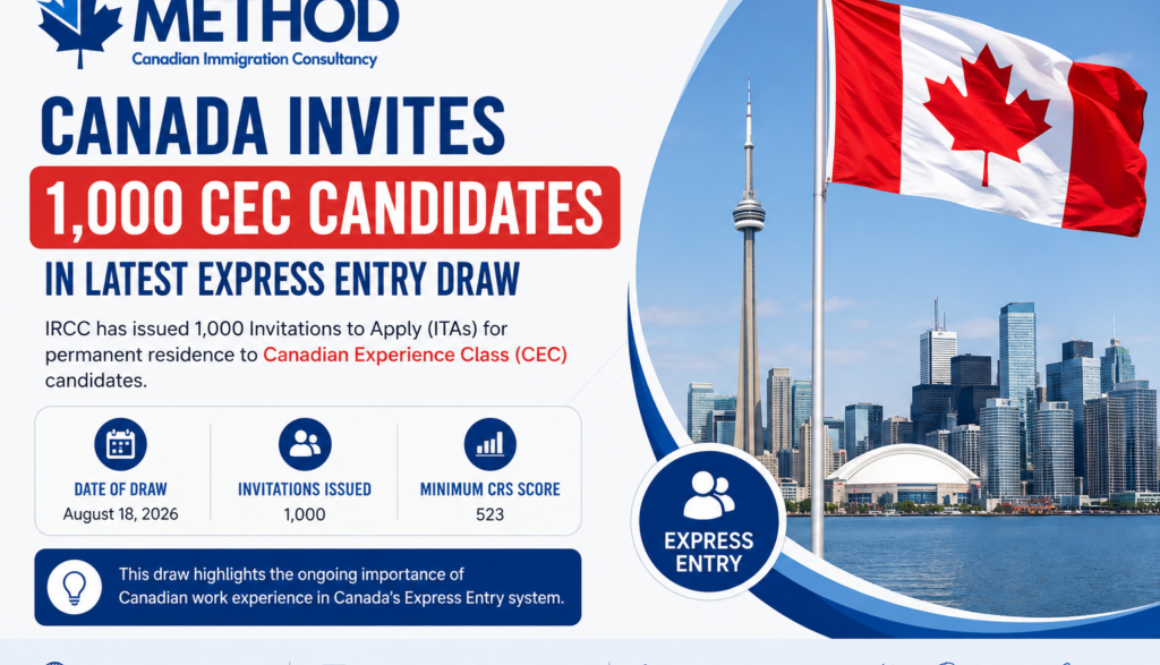
Immigration, Refugees and Citizenship Canada (IRCC) has issued 1,000 Invitations to Apply (ITAs) for permanent residence in its latest Express Entry draw targeting candidates in the Canadian Experience Class (CEC).
The draw, held on August 18, 2026, required candidates to have a minimum Comprehensive Ranking System (CRS) score of 523. Candidates also needed to have submitted their Express Entry profile before August 17, 2026, at 10:13 a.m. UTC to be eligible under the tie-breaking rule.
A Higher CRS Score for CEC Candidates
The latest draw saw the CRS cutoff increase compared with the previous CEC-specific draw earlier this month. On August 5, IRCC issued 3,000 invitations to Canadian Experience Class candidates, while the latest round issued 1,000 invitations.
This highlights how quickly Express Entry scores can change depending on the number of invitations issued and the number of high-scoring candidates in the pool.
Recent Express Entry pool data also showed continued competition among candidates with higher CRS scores. As of August 16, the number of candidates in the highest CRS ranges had increased, despite the overall Express Entry pool shrinking.
What Is the Canadian Experience Class?
The Canadian Experience Class is designed for eligible skilled workers who have gained qualifying work experience in Canada and want to transition to permanent residence.
To qualify, candidates must generally meet the requirements of the Canadian Experience Class and submit a profile through Canada’s Express Entry system. Eligible candidates are ranked against one another using the Comprehensive Ranking System, which considers factors such as age, education, language ability and Canadian work experience.
Receiving an Invitation to Apply does not automatically guarantee permanent residence. Candidates who receive an ITA must submit a complete application and provide the required supporting documentation within the applicable deadline.
What This Means for Express Entry Candidates
The latest CEC draw demonstrates that candidates with Canadian work experience remain an important part of Canada’s Express Entry immigration system. However, the increase in the CRS cutoff also shows that competition can remain strong, particularly when IRCC issues a smaller number of invitations.
For candidates currently in the Express Entry pool, improving a CRS score may be an important strategy. Depending on individual circumstances, this could include improving language test results, gaining additional skilled work experience, completing further education, or exploring eligibility for a provincial nomination or other Express Entry category.
IRCC has now issued 114,865 Invitations to Apply through Express Entry in 2026 across a range of draw categories, including the Provincial Nominee Program, Canadian Experience Class, French-language proficiency, healthcare and social services, physicians with Canadian work experience, senior managers, trades and transportation occupations.
Need Help With Your Express Entry Application?
Understanding your eligibility, calculating your CRS score and preparing a permanent residence application can be complicated. A mistake or missing document can cause delays or potentially affect the outcome of an application.
At Method Immigration, our team can help you understand your immigration options and assess your eligibility for permanent residence through Express Entry and other Canadian immigration pathways.
If you are currently in the Express Entry pool or are considering creating a profile, contact Method Immigration to discuss your options.
Canada’s Express Entry pool has decreased by more than 2,200 candidates, but the latest figures from Immigration, Refugees and Citizenship Canada (IRCC) show that competition remains strong among candidates with the highest Comprehensive Ranking System (CRS) scores.
According to the latest Express Entry pool distribution, the number of candidates in the pool fell from 229,100 on August 3 to 226,859 on August 16, a decline of 2,241 profiles.
However, the number of candidates with scores between 601 and 1,200 increased from 19,096 to 20,205 during the same period, highlighting continued pressure at the top end of the pool.
Largest decline occurs among candidates scoring 351–400
The biggest change was recorded among candidates with CRS scores between 351 and 400.
The number of profiles in this range fell by 1,507, from 50,107 to 48,600. Candidates with scores between 501 and 600 also declined significantly, falling by 1,048 profiles from 19,705 to 18,657.
Several other score ranges also recorded modest declines, while some higher-scoring ranges increased.
The 471–480 range increased by 258 candidates, while the 481–490 range increased by 176 candidates. The 461–470 range also grew by 76 candidates.
Express Entry pool distribution
CRS score range
August 16
Change since August 3
0–300
7,709
+26
301–350
17,269
+168
351–400
48,600
-1,507
401–410
10,688
-87
411–420
11,269
-57
421–430
11,890
-52
431–440
13,229
-38
441–450
13,555
-40
451–460
14,814
-31
461–470
16,133
+76
471–480
16,626
+258
481–490
13,066
+176
491–500
12,915
-24
501–600
18,657
-1,048
601–1,200
439
-61
Four Express Entry draws issued 8,807 invitations
The changes in the pool occurred following four Express Entry invitation rounds held between August 3 and August 16.
IRCC issued a combined 8,807 Invitations to Apply (ITAs) during this period:
August 4: 507 Provincial Nominee Program candidates — CRS 768
August 5: 3,000 Canadian Experience Class candidates — CRS 516
August 6: 5,000 French-language proficiency candidates — CRS 391
August 7: 300 Transport Occupations candidates — CRS 470
The August 7 draw marked IRCC’s first round of invitations under the revamped Transport category introduced earlier in 2026.
These targeted draws demonstrate the increasingly important role of category-based selection within Express Entry. Candidates who qualify for a specific category can potentially receive an invitation at a considerably lower CRS score than candidates competing in broader rounds.
For example, healthcare and social services draws in 2026 have had CRS cutoffs ranging from 467 to 475, while Canadian Experience Class draws have ranged from 507 to 518.
113,865 Express Entry invitations issued so far in 2026
The latest pool figures do not include the August 17 Provincial Nominee Program draw, in which IRCC invited 442 candidates with a minimum CRS score of 760.
Following that draw, IRCC had issued 113,865 ITAs through Express Entry in 2026, with Canadian Experience Class candidates accounting for 42.4% of invitations.
The August 16 pool distribution therefore provides a snapshot of the Express Entry system immediately before the latest PNP draw.
What the latest numbers mean for Express Entry candidates
The latest figures provide a mixed picture for prospective permanent residents.
On one hand, the overall Express Entry pool has contracted, with more than 2,200 fewer candidates than at the beginning of August. On the other hand, the continued presence of a large number of high-scoring candidates means that competition remains significant for candidates relying on higher CRS scores.
The data also reinforces the importance of category-based selection. Express Entry is no longer solely a competition based on achieving the highest possible CRS score. IRCC can select candidates based on factors such as French-language proficiency and targeted occupations, including healthcare and social services, trades, education and transport.
For candidates with CRS scores below the levels typically seen in Canadian Experience Class draws, qualifying for an applicable category or obtaining a provincial nomination may therefore provide an important alternative route to an invitation.
Express Entry candidates should continue monitoring both their CRS score and their eligibility for category-based selection as IRCC continues its invitation rounds throughout 2026.
Navigating an immigration application can be challenging. We provide a comprehensive application review service designed to help individuals and families submit accurate, compliant, and complete applications.
Each application undergoes a meticulous review. This includes examining documents for accuracy and consistency, verifying compliance with regulatory requirements, and ensuring all forms are properly completed. Our detailed approach minimizes the risk of errors that could delay or jeopardize your application.
Recognizing that every immigration journey is unique, we offer one-on-one consultations to understand your individual circumstances and objectives. This personalized service allows us to tailor our review process to meet your specific needs and ensure your application reflects your situation accurately.
Discuss your situation with us, have your credentials assessed to see which route is best for you, and see if you qualify to immigrate to Canada.
We recommend an introductory consultation for any new clients who are looking for guidance on their immigration process.
During these consultations, we explore the options available to you based on your situation, and provide a roadmap towards further actions and assistance that we can provide.
60 minute consultation with a Regulated Canadian Immigration Consultant – $180.
30 minute consultation with a Regulated Canadian Immigration Consultant – $105.
Consultations will be conducted by zoom video call.
If you are a student that wants to come to Canada to study at a Canadian institution (school, college or university), this category may be for you. You can study for a degree/diploma or any other accredited course on a study permit which is valid for the full length of your course. You may also be allowed to work in some circumstances to gain extra money on the side to fund your student lifestyle in Canada. We also process extensions to existing study permits for those of you who are already in Canada and have an expiring study permit. We also process Post Graduate Work Permits (PGWP) that are for recent graduates who may wish to work in Canada after they have completed their studies. If you want to see Canada while learning something new, then this category may be for you.
Express Entry
Express Entry is for skilled people that want to come to Canada and gain permanent residency. It is an online points-based system – you get points for your education, work experience, age, and language skills. Once you’ve added up your points, you will get placed in a pool of candidates. The candidates with the most points will then get picked out of this pool and will be invited to apply for their permanent resident visa. The more points you get, the more chance of you receiving an invitation to apply.
There are several categories for express entry, these include:
Canadian Experience Class (CEC) – this category is for people that have at least 1 year of Canadian work experience. Foreign Skilled Worker (FSW) – you don’t need Canadian work experience for this category, but you do need foreign work experience.
Foreign Skilled Trades (FST) – you don’t need Canadian work experience for this category but you do need work experience in a skilled trades role.
If you are looking to come to Canada and work on a temporary basis, this may be for you. You may have the intention to come to Canada on a temporary basis but then look into becoming a permanent resident – then this category also may be for you.
You may have a job offer in Canada that you want to accept or you may just want to work a ski season on the Mountains – whatever the reason is, this program may be for you.
We process open work permits as well as employer specific work permits. We also process extensions to existing workers for those of you who are already in Canada and have an expiring work permit. We also deal with companies and corporations who may be looking to hire temporary foreign workers in Canada – see LMIA.
LMIA
If you are an employer who is looking to hire temporary foreign workers in Canada, then you must obtain an LMIA. We process LMIAs and also the work permit Applications for your temporary foreign workers. An LMIA is also used to support a skilled worker achieve their permanent residency status. If you are a current employee and your employer is willing to support you in your permanent residency application, then this program is for you. We can process the whole application including your permanent residency file. The LMIA process is a long and complex one, but hiring us to assist you in this process will make it much more stress free and easy to deal with.
Parent/ Grandparent Supervisa
Parent/Grandparent Supervisas are a helpful way to be able to see your children/grandchildren without being limited to only a visitor visa (usually only granted for 12 weeks). You are able to visit your children/grandchildren up to 5 years at a time for a period of 10 years.
It is also a much quicker application than a sponsorship application and is not subject to paying a permanent residency fee.
Book a consultation to discuss if this might fit your case, and we will provide a step by step process, as well as guidance, on applying for the supervisa.
Caregiver Visas
If you are currently a care giver for children, elderly or other people that may need care, you can apply for a Caregiver visa. This allows carers to become permanent residents of Canada while doing the job they love. Whether you are a home child care worker or home support worker you may apply if you already have a job.
Family Sponsorship
The Family Sponsorship category is for Canadian Citizens and Permanent Residents to be able to sponsor a family member to come to Canada and gain their permanent residency. It could be spouses, children, parents, grandparents and in some cases Brothers, Sisters, Uncles, Aunties, Cousins, Nephews & Nieces. Similarly if you are a foreign national that has a family member in Canada who is already a permanent resident or Citizen, this category may be for you.
This category also includes the parent/grandparent super visa, which allows parents/grandparents of a permanent resident or Canadian Citizen to come to Canada for several months throughout the year without actually having to sponsor them. Finally, the family sponsorship category also allows you to adopt a child to Canada.
We have completed a whole range of family sponsorship applications so please let us know your situation and we may be able to help.
Provincial Nominee Program (PNP)
Are you considering immigrating to Canada and looking to apply under the Provincial Nominee Program (PNP)? Each province and territory in Canada has its own unique PNP and the eligibility criteria and minimum requirements for each program can vary. Some of the different streams that provinces and territories may have under their PNP include entrepreneur programs, graduate streams, in-demand skills streams and French speaker programs.
When it comes to applying under the PNP, you have two options: Express Entry or paper-based application. If you choose to apply through Express Entry, you can indicate your interest in a specific province or territory and if they are interested in your profile they may send you a Notification of Interest (NOI). If you receive an NOI, you can then apply for a nomination from the province or territory.
If you are nominated by a province or territory, and you meet the eligibility criteria and minimum requirements, you will be able to apply for permanent residence through Express Entry. It’s worth noting that 80% of Express Entry PNP applications are processed within 6 months, making it a fast-track option for applicants looking to immigrate to Canada.
It’s important to research and compare the different PNP streams offered by each province and territory to determine which program is the best fit for you. Some provinces and territories have more frequent rounds of invitations than others and some programs may have a lower minimum requirement for language or experience. Also, Keep in mind that some provinces and territories may not be accepting applications at all times.
In any case, the immigration process can be complex, so it’s always a good idea to seek professional help if necessary. With the right research and guidance, you can increase your chances of success and find the perfect program to help you achieve your goal of immigrating to Canada.