
Method Immigration
  • About
  • Services
    • Provincial Nominee Program (PNP)
    • Family Sponsorship
    • Study Permits
    • Express Entry
    • Temporary Work Permit
    • LMIA
    • Parent/Grandparent Supervisa
    • Caregiver Visas
  • News
  • Pricing
  • Contact
  • Book Now
Method Immigration
August 13 2026

Canada Updates PR & Citizenship Processing Times

MethodImmigration Uncategorized

Canada’s immigration department has released its latest processing-time estimates for permanent residence and citizenship applications, with some applicants seeing shorter waits while others continue to face lengthy delays.

Immigration, Refugees and Citizenship Canada (IRCC) updated its processing-time estimates on August 10. The latest figures show that processing times remain relatively stable across many immigration programs, although there have been notable changes for Federal Skilled Worker Program applicants, Provincial Nominee Program applicants and family sponsorship applications.

Express Entry processing times improve for Federal Skilled Workers

One of the more positive developments is a reduction in processing time for applicants under the Federal Skilled Worker Program (FSWP).

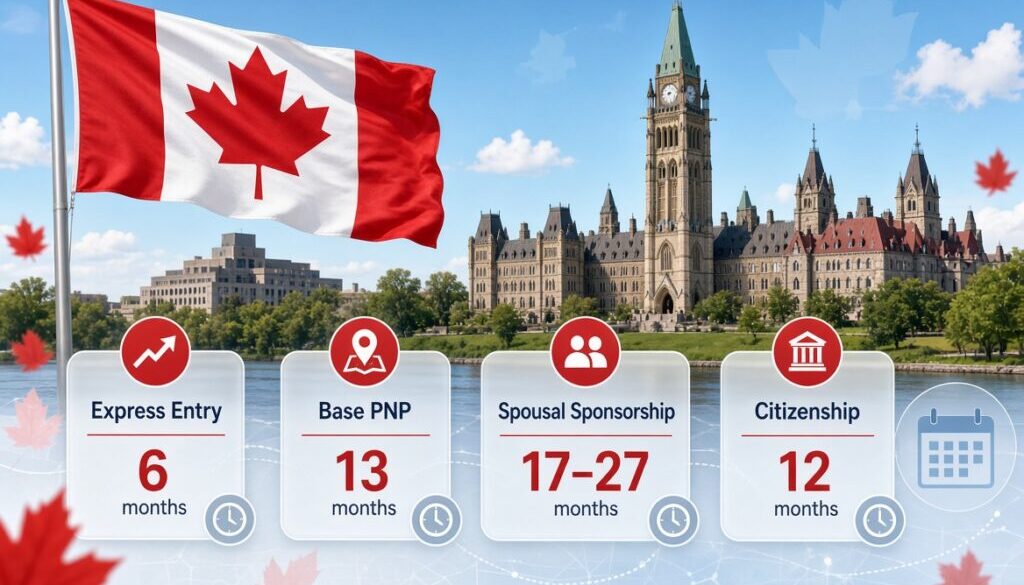
The estimated processing time has fallen from seven months to six months, bringing it in line with the Canadian Experience Class (CEC), which remains at six months.

Current Express Entry processing estimates are:

  • Canadian Experience Class: 6 months
  • Federal Skilled Worker Program: 6 months
  • Federal Skilled Trades Program: No processing estimate published

IRCC’s service standard for Express Entry programs remains six months.

The department also reported reductions in the inventory awaiting assessment. The CEC inventory decreased by approximately 1,800 applications, while the FSWP inventory fell by approximately 3,400 applications compared with the previous update.

For prospective immigrants considering Express Entry, the latest figures suggest that the federal skilled immigration system continues to operate close to IRCC’s established six-month service standard for applications in these streams.

Base PNP processing time increases

The latest update also highlights a more challenging trend for applicants under Canada’s Provincial Nominee Programs.

Processing for non-Express Entry, or base PNP applications, has increased from 12 months to 13 months.

This increase occurred even though IRCC reduced the number of base PNP applications awaiting assessment by approximately 1,400.

Enhanced PNP applications processed through Express Entry remain at an estimated seven months.

The current figures are:

  • Enhanced PNP: 7 months
  • Base PNP: 13 months

The increase demonstrates that a reduction in the number of applications in the queue does not necessarily result in an immediate reduction in processing times. IRCC’s estimates also take projected processing capacity and application inventory into account.

Family sponsorship waits remain lengthy

Processing times for spousal sponsorship applications remained unchanged in the latest update.

For applicants outside Quebec, IRCC currently estimates:

  • Spouse or common-law partner inside Canada: 27 months
  • Spouse or common-law partner outside Canada: 17 months
  • Parents and Grandparents Program: 29 months

There was a modest improvement for parents and grandparents, with the estimated processing time decreasing from 30 months to 29 months.

Applicants intending to settle in Quebec continue to face longer processing estimates. Spousal applications involving a partner inside Canada are estimated at 32 months, while applications involving a spouse or partner outside Canada are estimated at 33 months.

For the Parents and Grandparents Program, the current estimate for applicants intending to settle in Quebec is 64 months, down from 65 months.

Some economic immigration programs continue to face extreme delays

Not all immigration programs have seen meaningful improvements.

The Atlantic Immigration Program remains at an estimated 26 months, despite IRCC removing approximately 200 applications from its inventory since the previous update.

Even more significant are the delays affecting the Start-up Visa Program and the Federal Self-Employed Persons Program.

Both programs continue to have estimated processing times of more than 10 years.

IRCC’s inventory includes approximately 47,600 Start-up Visa applications and 8,000 Federal Self-Employed Persons Program applications awaiting assessment.

These extended timelines are important for prospective applicants to consider when evaluating whether a particular immigration pathway remains appropriate for their circumstances.

Citizenship processing remains stable

For most citizenship applicants, the latest update brings little change.

The estimated processing time for a citizenship grant remains 12 months, which is also IRCC’s service standard.

However, applicants seeking to renounce Canadian citizenship have seen a significant improvement. Processing time has fallen from seven months to four months.

The estimated processing time for a search of citizenship records remains 17 months.

Despite the stable processing estimate for citizenship grants, IRCC’s inventory increased slightly. As of August 10, approximately 328,200 citizenship grant applications were in inventory, about 2,000 more than in the previous update.

Processing times are estimates—not guarantees

Applicants should remember that IRCC processing times are estimates rather than guaranteed deadlines.

The actual processing time for an individual application can vary depending on factors such as whether an application is complete, the complexity of the case, and whether IRCC needs additional documents or information.

IRCC uses both historical and forward-looking estimates when calculating processing times. Historical estimates are based on how long it took to finalize most similar applications in the past, while forward-looking estimates take current inventory and anticipated processing capacity into account.

This means applicants should not assume that their application will necessarily be finalized exactly within the published timeframe.

What should applicants do?

The latest processing-time update highlights an important point for anyone planning to immigrate to Canada: choosing the right immigration pathway remains critical.

While some programs are moving closer to their service standards, others continue to experience significant delays.

Applicants should review their options carefully before submitting an application and ensure that their application is complete and supported by the required documentation. An incomplete application or a request for additional information from IRCC can add further time to the process.

Processing times can also change from month to month as IRCC’s inventory, application volumes and processing capacity change.

For applicants already waiting for a decision, the latest estimates can provide a useful indication of current timelines—but should not be treated as a guaranteed decision date.

The latest IRCC update shows a mixed picture: some applicants are seeing modest improvements, while others continue to face processing times measured in years. For anyone considering Canadian permanent residence or citizenship, staying informed about these changes can help with planning and choosing the most appropriate immigration strategy.

Processing times referenced in this article are based on IRCC’s August 10, 2026 update and may change as new estimates are released.
BC PNP Skills Immigration: Ineligible Occupations Update

Related Posts

Method Immigration

Uncategorized

Latest Express Entry Draw: Provincial Nominees Invited

Method Immigration

Uncategorized

Canada Halts New Parent/Grandparent Sponsorships

Method Immigration

Uncategorized

Future-Proof Your Canada Immigration Plan in 2026

Popular Posts

  • Canada Updates PR & Citizenship Processing Times
  • BC PNP Skills Immigration: Ineligible Occupations Update
  • Latest Express Entry Draw: Provincial Nominees Invited
  • Canada Halts New Parent/Grandparent Sponsorships
  • Future-Proof Your Canada Immigration Plan in 2026

Application Review

Navigating an immigration application can be challenging. We provide a comprehensive application review service designed to help individuals and families submit accurate, compliant, and complete applications.

Each application undergoes a meticulous review. This includes examining documents for accuracy and consistency, verifying compliance with regulatory requirements, and ensuring all forms are properly completed. Our detailed approach minimizes the risk of errors that could delay or jeopardize your application.

Recognizing that every immigration journey is unique, we offer one-on-one consultations to understand your individual circumstances and objectives. This personalized service allows us to tailor our review process to meet your specific needs and ensure your application reflects your situation accurately.

Click here to learn more 


Consultation (General or Intro)

Discuss your situation with us, have your credentials assessed to see which route is best for you, and see if you qualify to immigrate to Canada.

We recommend an introductory consultation for any new clients who are looking for guidance on their immigration process.  

During these consultations, we explore the options available to you based on your situation, and provide a roadmap towards further actions and assistance that we can provide. 

  • 60 minute consultation with a Regulated Canadian Immigration Consultant – $165.
  • 30 minute consultation with a Regulated Canadian Immigration Consultant – $95.

Consultations will be conducted by zoom video call.

Book a consultation

Study Permits

If you are a student that wants to come to Canada to study at a Canadian institution (school, college or university), this category may be for you.  You can study for a degree/diploma or any other accredited course on a study permit which is valid for the full length of your course.  You may also be allowed to work in some circumstances to gain extra money on the side to fund your student lifestyle in Canada.  We also process extensions to existing study permits for those of you who are already in Canada and have an expiring study permit.  We also process Post Graduate Work Permits (PGWP) that are for recent graduates who may wish to work in Canada after they have completed their studies.  If you want to see Canada while learning something new, then this category may be for you.

Express Entry

Express Entry is for skilled people that want to come to Canada and gain permanent residency.  It is an online points-based system – you get points for your education, work experience, age, and language skills.  Once you’ve added up your points, you will get placed in a pool of candidates.  The candidates with the most points will then get picked out of this pool and will be invited to apply for their permanent resident visa.  The more points you get, the more chance of you receiving an invitation to apply.

There are several categories for express entry, these include:

Canadian Experience Class (CEC) – this category is for people that have at least 1 year of Canadian work experience.
Foreign Skilled Worker (FSW) – you don’t need Canadian work experience for this category, but you do need foreign work experience.  

Foreign Skilled Trades (FST) – you don’t need Canadian work experience for this category but you do need work experience in a skilled trades role.

Provincial Nominee Program (PNP) – See PNP.

Temporary Work Permit

If you are looking to come to Canada and work on a temporary basis, this may be for you.  You may have the intention to come to Canada on a temporary basis but then look into becoming a permanent resident – then this category also may be for you.  

You may have a job offer in Canada that you want to accept or you may just want to work a ski season on the Mountains – whatever the reason is, this program may be for you.  

We process open work permits as well as employer specific work permits.  We also process extensions to existing workers for those of you who are already in Canada and have an expiring work permit.  We also deal with companies and corporations who may be looking to hire temporary foreign workers in Canada – see LMIA.

LMIA

If you are an employer who is looking to hire temporary foreign workers in Canada, then you must obtain an LMIA.  We process LMIAs and also the work permit Applications for your temporary foreign workers.  An LMIA is also used to support a skilled worker achieve their permanent residency status.  If you are a current employee and your employer is willing to support you in your permanent residency application, then this program is for you.  We can process the whole application including your permanent residency file.  The LMIA process is a long and complex one, but hiring us to assist you in this process will make it much more stress free and easy to deal with.

Parent/ Grandparent Supervisa

Parent/Grandparent Supervisas are a helpful way to be able to see your children/grandchildren without being limited to only a visitor visa (usually only granted for 12 weeks). You are able to visit your children/grandchildren up to 5 years at a time for a period of 10 years.

It is also a much quicker application than a sponsorship application and is not subject to paying a permanent residency fee. 

Book a consultation to discuss if this might fit your case, and we will provide a step by step process, as well as guidance, on applying for the supervisa. 

Caregiver Visas


If you are currently a care giver for children, elderly or other people that may need care, you can apply for a Caregiver visa. This allows carers to become permanent residents of Canada while doing the job they love. Whether you are a home child care worker or home support worker you may apply if you already have a job.

Family Sponsorship

The Family Sponsorship category is for Canadian Citizens and Permanent Residents to be able to sponsor a family member to come to Canada and gain their permanent residency.  It could be spouses, children, parents, grandparents and in some cases Brothers, Sisters, Uncles, Aunties, Cousins, Nephews & Nieces.  Similarly if you are a foreign national that has a family member in Canada who is already a permanent resident or Citizen, this category may be for you. 

This category also includes the parent/grandparent super visa, which allows parents/grandparents of a permanent resident or Canadian Citizen to come to Canada for several months throughout the year without actually having to sponsor them.  Finally, the family sponsorship category also allows you to adopt a child to Canada. 

We have completed a whole range of family sponsorship applications so please let us know your situation and we may be able to help.

Provincial Nominee Program (PNP)

Are you considering immigrating to Canada and looking to apply under the Provincial Nominee Program (PNP)? Each province and territory in Canada has its own unique PNP and the eligibility criteria and minimum requirements for each program can vary. Some of the different streams that provinces and territories may have under their PNP include entrepreneur programs, graduate streams, in-demand skills streams and French speaker programs.

When it comes to applying under the PNP, you have two options: Express Entry or paper-based application. If you choose to apply through Express Entry, you can indicate your interest in a specific province or territory and if they are interested in your profile they may send you a Notification of Interest (NOI). If you receive an NOI, you can then apply for a nomination from the province or territory.

If you are nominated by a province or territory, and you meet the eligibility criteria and minimum requirements, you will be able to apply for permanent residence through Express Entry. It’s worth noting that 80% of Express Entry PNP applications are processed within 6 months, making it a fast-track option for applicants looking to immigrate to Canada.

It’s important to research and compare the different PNP streams offered by each province and territory to determine which program is the best fit for you. Some provinces and territories have more frequent rounds of invitations than others and some programs may have a lower minimum requirement for language or experience. Also, Keep in mind that some provinces and territories may not be accepting applications at all times.

In any case, the immigration process can be complex, so it’s always a good idea to seek professional help if necessary. With the right research and guidance, you can increase your chances of success and find the perfect program to help you achieve your goal of immigrating to Canada.